When I watch Stéphane Audran's work, I believe her to be the epitome of economic acting and control (as The Dench is). She possesses the subtlest of subtleties and on screen, for me atleast, they are magnified. She seems to do nothing but in that nothing there is a BIG something. She's effortless. Calm in her activity.
You are immediately drawn to her face. Her eyes, her high cheekbones, and then that voice of hers from her mouth. She plays with her voice; she grunts or hems & haws or ohs. It's quite wonderful to hear and funny. Having said that, it's the same with her facial expressions. They're very small yet telling and then yet mysterious. You wonder why she smirks or why her eyes glow, etc. I always want to know what she is thinking (as I do with Romy Schneider) at that very moment. She has a languid, natural walk. She seems to be an ice queen but there's a deep warmth and playfulness in her. She really takes her time.
Needless to say, I am enamored with her. Obsessed? Perphaps. But, that's what good acting does to me. Clalk it all up to God. He gave me a gift and I am always reminded of it. I can never stop thinking of it (or TALKING about it).
Okay, this is not about me. This is about another great actress that I have come across. If I worked with her and then died, that would be okay. It would suck but I would have gotten to work with such an actress. Here are the films I have seen her in:


This film! Le Charme Discret de la Bourgeoisie 1972, directed by Luis Buñuel. I watched it a LONG time ago. I don't even remember WHY I picked it up from the library. I do, however, remember watching it and being lost. Surreal. LOL! It's about a group of 6 people and their unsuccessful attempts at having a meal together. Scene after scene there is, without fail, an interruption. Whether it be terrorists, being arrested, discovering that they are on a live stage, etc. It is so bizarre. I think I liked it (?). I know NOW I will! Ha! I also remember Stéphane's character wanting to get it on with her husband. There's a scene where she wants to do it in the garden with her husband and another right before that in the bedroom where he says, "You make too much noise." Ah-hah! I've got to get my hands on this film again. I just need to watch it again (and again and again). It just came to me that I think I got this film because of Jeanne Moreau. She wasn't in it BUT she was directed by Buñuel and if I couldn't get my hands on the film she did with him, this was the next best thing to see what he was all about. It seems like it would be a riot all the way through but I believe there were some rather violent and disturbing scenes. It is Buñuel, afterall.


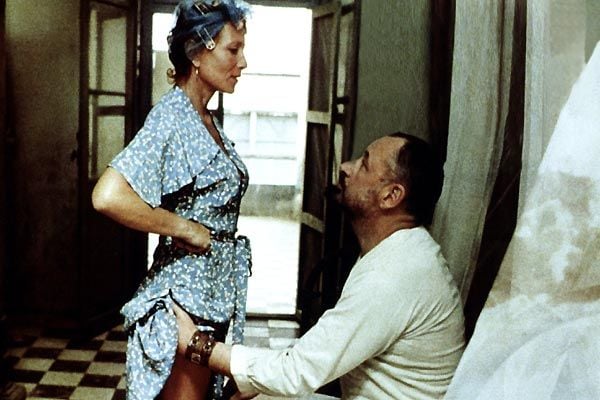
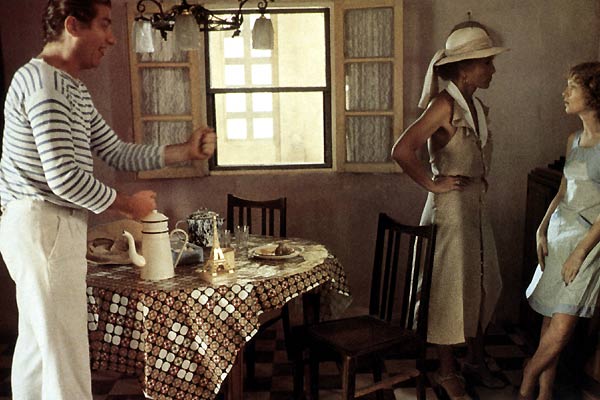
Coup de Torchon 1982, directed by Bertrand Tavernier. I watched this a while back when I was first researching about Isabelle Huppert. I don't remember it at all. I just wasn't as aware, I suppose. I'm a late-bloomer. Stéphane plays Philippe Noiret's wife. I really don't remember a thing! I only remember scenes with Isabelle being spriteful and naked! Ha! I think I remember that I thought Stéphane was gorgeous and sexy. I really can't talk about this film because I'm old and seriously canNOT remember. Mm. (Netflix, anyone? It is next in the queue!!!)


This film Les Biches was made in 1968 by her second husband, Claude Chabrol. And, no. The title does not mean what you think it means. It literally translates to, "The Does," (as in Doe a deer a female deer) not, "The Bitches." Oh! I must not forget to say that this film contains one of THE MOST BRILLIANT cuts I have EVER seen. AND, I am not speaking in hyperboles. Watch it and you will know what I am talking about. She plays Frédérique, a woman who is bored and has money. Jacqueline Sassard plays, Why, (yes, that's her name in the film) a young, floater of an artist with a fragile mind who draws does on the pavement, and gets some loose change here and there from passers-by and on-lookers; BUT receives a nice, crisp, folded 500note from the woman in black who happens to be Frédérique. The tension between the 2 of them right from the start! You would need an ax (!) to cut through it. Yes, that thick. She takes her on as her "protégé," and takes her to her place in St Tropez where she lives with these 2 clowns that happen to be gay (which I did not get at all. It's not because I'm stupid, I just don't automatically think that) and her cook. Everything seems to be fine (if things can be fine in a Chabrol film) until Paul (played by Jean-Louis Trintignant, Stéphane's first husband-in her real life) enters into their lives. Stéphane is so controlled and elegant; also there's a scene where she reverts to a child's wobbly and awkward physicality as she must confess to Why about what she has done with Paul. This woman is just gorgeous and on top of that she's so good at what she does! One of my favorite scenes is when she is introducing Why to her cook. Another is when Why comes home after her night with Paul and Frédérique calls her out to where she is having her breakfast. Can you say, "comedy?" Also, her drunk scene with Paul is precise. I believe she did make an impact on me with, "Bourgeoisie," but I was too stranged-out to understand and not aware as I am today. And, stupidly, I can't remember a thing in, "Coup de Torchon," except Isabelle speaking at a rapid pace, Philippe Noiret being a ferocious teddy bear and possibly thinking Stéphane as gorgeous! Ha! "Les Biches," is where, right from the start, she made a HUGE impact on me. There were 2 video clips of scenes that I watched on YouTube and DailyMotion that peaked my curiosity about this film. So, thank you to those video sharing sites!!! Oh! There is a scene in which Why goes to Frédérique and Paul's room. She stays outside and just listens. No words are exchanged between the 3 of them. It's some scene.


Les Bonnes Femmes 1960, directed by Chabrol. This is a film about 4 Parisian shopgirls (Jane, Jacqueline, Ginette and Rita) and their humdrum lives filled with their struggles, hopes and dreams (or disillusions) of love. Here, Stéphane plays Ginette who hides a secret from her friends about what she does after hours. The girls suspect that it's a new beau. They are taken aback when they find out but become supportive of her (though, I read them as thinking that she were mediocre). It's an ensemble piece, really. But, one of the character's stories takes over coming to the end of the film. And the way it ends. *le whew* Jacqueline falls for a man who rides a motorcycle that follows her every where she goes. There are 2 moments in the same scene with the same action that happen between Jacqueline and her motorcycle man. It's such a tender gesture that they both do at separate times. His hand is over hers and his finger gently slides under her sleeve. Towards the end of the scene, Jacqueline returns the gesture. *le chills* Jane is the wild girl of the group and right at the beginning gets herself into a position (or several, who knows?) with 2 men that I absolutely detested and wanted to kill (HA!). Rita is the one in the group that is engaged to a guy that tries to mold her into what he thinks/knows his parents want. *ugh* There's a scene in a restaurant where Rita's fiancé is reciting (rapidly) to her what she should know about Michaelangelo as both his parents walk into the restaurant. Man! Chabrol is the best at examining the psychology of individuals. Or should I say, he's the best at brewing and simmering in a person's psychology? He's also a master at keeping you thrilled. People say that he is "The French Hitchcock." I think that's a horrible label. Yes, he is influenced by Hitchcock's work but he is a director, a great one, in his own right. It's a nice compliment but don't label him with that. That is, unless he likes it. I'll ask him the day I work with him!


La Femme Infidèle 1969, directed by Chabrol. This film was remade into, "Unfaithful," the film starring Diane Lane, Richard Gere and Olivier Martinez. I never saw it. Though, remakes tend to be flat and lose the initial "freshness" of the original. Usually. Then, when you try to remake a European film! The flair is gone because it has been "Americanized." BUT, like I said, I never saw it. Chabrol is a master storyteller, truly. And he knows how to choose the actors to bring his stories to life. He's powerful and understated. There is always something looming, compelling in his characters. Watching his films is like peeping through a keyhole or possibly being in the same room, and feeling that uncomfortable awkwardness that fills the air so quick and thick in a room, or that distinct distress/torture that comes over when someone has gone too far. Obviously, one should know what the film is about just from the title. What is great about it is that it focuses on the forsaken husband. Michel Bouquet plays the husband. He is one of THE most versatile actors, truly. The first film I ever saw him in was, "La Mariée était en noir," with Jeanne Moreau. He was a blithering, socially-awkward, lonely man who couldn't believe that Jeanne's character could see something in him (which she didn't. What she could see in him was the poison she gave to him! WHOOPS). WELL, onward with this film... I wish that I could find info on the kid that played their son. He was adorable and good but I don't know his real name. He had great eyes. *ugh* Chabrol is very sensitive and never sentimental. A prime example is the scene where Hélène goes into her room, she is very depressed because of her lover's absence, she falls to her bed, the camera fades in closer to her and she is weeping. BUT, there are only 3 mini, barely audible sobs that are produced from her voice. It's most effective. Other actresses would have handled it differently, but in the hands of Stéphane! Mm! The choices she makes are so fresh and refreshing. Inner turmoil. And it's not just her, it's with many of Chabrol's characters. Another great moment of hers is when she is emptying her husband's coat pockets. In the inside pocket is a photo of her lover. Yikes! Speaking of her choices, they're never obvious and there usually is a dash of humor underneath it all. She's so intricate and meticulous in her manners and gestures. The way she uses her voice... It's so rare these days to have ONE actress like her! It's so natural for Stéphane.


Le Boucher 1969, again directed by Chabrol. One thing (among many) that I love about a Chabrol film is...FOOD. He always seems to have food in his films. And Stéphane knows how to eat. I love watching her eat in the films. I love to eat on stage and I love to see other actors eating. Strange, I know. It's interesting. Another thing is his use of color, and also, the ambiguity of the time period he is filming in. His films can take place at any time in the present (you'll notice his "set" and the costumes that are worn are not very "period"). Hélène (Audran) is the young headmistress of the local school. Popaul is the butcher of the village (he promises to give her the best cut and freshest meats. So thoughtful and rather odd. There is a scene where he hands Hélène some meat and it reminded me of a bouquet of flowers! HA!). Hélène's heart was broken long time ago and she has decided to no longer enter to any relationship because she does not want to risk being hurt deeply again. They say she is repressed (in articles I've read about the film) but she isn't the stereotypical, "repressed." You see, I would have never labeled her character with that word. When you see it, you'll know what I mean. Murder is in the air in this film, with the police trying to solve who did it and why. Hélène embraces the companionship of Popaul but doesn't want to go any further to protect her heart. In one scene, Popaul talks of wanting to ask Hélène if he could kiss her and she says that she wishes he wouldn't ask. Earlier, she has given him a lighter as a present for his birthday. The lighter plays a significant part in the film. Try not to miss her actions in the scene with the detective in her classroom. He lights his cigarette. Watch where Hélène's eyes go. She is... there are just too many words that won't suffice.


La Rupture 1970, directed by Chabrol. I've read that this film is often forgotten. I don't know why. It holds up with the others fine. It's authenticity versus convention. Despite, Hélène's (Audran) past jobs as a stripper, taxi-girl, barmaid, whatever(!), she is the saint in the film. No joke. Now, this film contains THE MOST HARROWING opening I have EVER seen. Try to disagree with me after you see it. And right after that scene, the credits roll. *le whew* Of course! One of the themes is that of the wealthy, their wealth and the misuse/abuse of it. Also, the seduction and suction of money, and what people will do or not do for it. It's sort of a whacked out film especially towards the end when you get into the antagonist's Plan B to get dirt on Hélène. He can't dig up any dirt on her so he creates this scheme against her. The whole time, I was yelling, "Don't do it," or, "Don't take it," or, "I hate him!" or "UGH!!!", etc. HA!
**
A nice common element in Chabrol's films that I've seen is humor. It's such a wonderful layer to be included. These days he does not use his ex-wife in his films. They were married in 1964 and divorced in 1980, yet they still worked together on some projects. In an article I read last night (I have been tirelessly researching about her but there's hardly anything out there! It's worse than Romy!), an interviewer asked Chabrol why he and Stéphane divorced. He said that he became more interested in her as an actress than a wife. They had one son together, Thomas Chabrol. These days, Chabrol uses another favorite of mine, Isabelle Huppert. I await the day that I see the film, "Violette," in which Isabelle and Stéphane co-star.
André Génovès was his producer. Jean Rabier was his cinematographer. Pierre Jansen was his composer. Jacques Gaillard was his editor. What a team! Exceptional. I want to be the actress that is part of something like that, today. One day. Wow.
I write all this in haste because I just wanted to put a little sump-in', sump-in' up on Stéphane. So, bear with me and my girlish squealings. (There is also a LIKELY chance that I will be coming back to this and adding/changing stuff) And by the buy...it took me FOREVER to write this even if I was hasty!
She has also made appearances on the stage:
1955 La Maison Carrée
1957 Le Nuit Romaine
1963 Macbeth
I Love Stéphane Audran